Planning
Unit:
Year:
2008
‐
2009
Unit
Type:
Report
Period:
July
1,
2008
–
June
30,
2009
(Choose
One:
Educational
Programs,
Administrative
Support,
Educational
Support,
Workforce
Development)
(1)
Unit
Mission:
(2)
(3)
(4)
(5)
(6)
(7)
Strategic
Focus/College
Goal
(SF#
and/or
CG#)
Desired
Outcome
&
Target/Criterion
(Outcome
begins
with
verb,
Target
numerically
measurable)
Strategy
To
Accomplish
Desired
Outcome
(Use
bullets)
Budge
t
Link
(Yes
or
No)
Assessment
Method/
Instrument
Findings
&
Use
of
Results
for
Improvement
(Use
bullets)
CG#
1,
2,
3
&
5
A.
Desired
Outcome
#1
:
Improve
the
ACF
certification
exam
pass
rates.
•
Identify
areas
of
weaknesses
of
unsuccessful
students;
•
Unsuccessful
students
will
be
advised
and
re
‐
mediated;
•
Re
‐
administer
the
written
exam;
•
Strengthen
the
areas
of
weakness
in
related
course
work;
•
Curriculum
change
(split
course
into
2
courses)
to
allow
more
time
for
cer
tification
preparation.
N
Review
National
Apprenticeship
Exam
letters
to
students.
A.
Findings
:
•
100%
of
students
who
participated
in
the
certified
culinarian
written
exam
were
successful.
Target
Met
B.
Target/Criterion
:
90%
pass
rate
on
certified
culinarian
written
exam.
B.
Use
of
Results
:
•
Outcome
concluded
Culinary
Arts
Educational
Program
In
keeping
with
the
mission
statement
of
Delgado
Community
College,
the
Culinary
Arts
department
provides
academic
instruction
and
supervised
practical
work
experience
in
the
field
of
food
service.
CULA Assessment Plan 2008-2009, page 1
(2)
(3)
(4)
(5)
(6)
(7)
Strategic
Focus/College
Goal
(SF#
and/or
CG#)
Desired
Outcome
&
Target
(Criterion)
(Outcome
begins
with
verb,
Target
numerically
measurable)
Strategy
To
Accomplish
Desired
Outcome
(Use
bullets)
Budge
t
Link
(Yes
or
No)
Assessment
Method/
Instrument
Findings
&
Use
of
Results
for
Improvement
(Use
bullets)
CG#:
2,
3
&
5
A.
Desired
Outcome
#2
:
Prepare
students
for
employment
in
the
field.
•
Develop
graduate
and
employer
surveys
N
Surveys
–
Graduate
and
Employer
A.
Findings
:
•
100%
of
the
respondents
indicated
that
they
were
employed
in
the
field.
Target
Met
B.
Target/Criterion
:
75%
of
the
graduates
will
be
employed
in
the
field.
B.
Use
of
Results
:
•
Met
with
an
outside
consultant
who
reviewed
the
program.
Results
are
pending.
CG#:
2,
3
&
5
A.
Desired
Outcome
#3
:
Demonstrate
students’
practical
knowledge
and
competencies
to
be
successful
culinarians
in
the
work
place.
•
Meet
with
supervising
chef
to
determine
where
the
weaknesses
are
to
determine
course
of
action.
•
Students
required
to
attend
outside
classroom
instruction
to
ensure
their
success
and
offer
guidance
through
the
process
of
supervised
wor
k.
N
Documents
‐
log
book,
industry
chef
evaluations
A.
Findings
:
•
100%
of
a
random
sample
of
student
log
book
evaluations
indicated
they
achieved
greater
than
70%.
78%
of
the
students’
achieved
greater
than
70%
as
indicated
by
industry
chef
evaluations.
Target
Partially
Met
B.
Target/Criterion
:
90%
of
the
students’
will
successfully
achieve
greater
than
70%
in
CULA
281
‐
286.
B.
Use
of
Results
:
•
Continue
with
practice
of
meeting
with
students
outside
of
class
times
to
discuss
job
and
employer
expectations.
CULA Assessment Plan 2008-2009, page 2
Associate of Applied Science Culinary Arts
Use of Assessment Results
2008-2009
Date Prepared: March 1, 2010
Desired Outcome #1:
Improve the ACF certification exam pass rates.
Target:
90% pass rate on certified culinarian written exam.
Findings:
•
100% of students who participated in the certified culinarian written exam were
successful.
Updated Use of Results:
•
The outcome target was met. The program has developed and received approval
for a Culinary Certification Preparation course, CULA-218, to assist students in their
preparation for certification.
Evidence Attached:
A. Master Syllabus: CULA-218: Culinary Certification Preparation
CULA Outcome #1: Summary
Page 1 of 3
CULA 218, Culinary Certification Preparation
ourse Lecture-Lab-Credit and/ Contact Hours
: 2 - 3 - 2 / _75____
C
ourse Maximum Enrollment:
_______12_______
Lab Fee
: ___60.00_________
quired smallwares,
wed
er, safe,
tified
immediately. Accidents must be reported to the instructor immediately.
rian written and practical exams. Both exams will be
dministered during the semester.
isite and/or co-requisite courses
ased on skill and experience levels required for the course.
Pre-req
A 216, CULA
217, CULA 281, CULA 282, CULA 283, CULA 284, CULA 285
Co-requisite(s):
tudent to achieve Certified Culinarian
certification through the American Culinary Federation.
C
Special Facility or Equipment Needs/Safety Rules and Issues
:
ACF approved culinary teaching laboratory/kitchen with the re
working area and equipment all in safe, sanitary, and working order.
All students will report to class in a clean, complete uniform as described in the DCC
Culinary Arts Hygiene Policy. Students are required to have an official DCC Culinary
Arts Toolkit. No other toolkits or sets will be allowed in class. Students are not allo
to borrow tools. Students are expected to work in a professional, safe, and sanitary
manner. Any student engaging in horseplay, use of drugs, alcohol, or any behavior
deemed unacceptable by the instructor, will be removed and sent to the Director of
Student Life for disciplinary action. The student is not to use any piece of equipment that
they have not received instruction for proper usage, or that they feel is not in prop
working order. All spills or other safety hazards are to be cleaned up or rec
* * * *
Course Description
: A course to prepare Delgado apprentices to take both the American
Culinary Federation Certified Culina
a
Pre- and/or Co-requisites
: Specify the appropriate pre-requ
b
uisite(s):_____ Successful completion with a "C" or better in CULA 101, CULA
102, CULA 103, CULA 105, CULA 106, CULA 107, CULA 208, CULA 209,
CULA 210, CULA 211, CULA 213, CULA 214, CULA 215, CUL
Course Goal
: The goal of this course is to prepare the s
CULA Outcome #1 (A): CULA-218 Syllabus; used beginning Fall 2009, page 1
Page 2 of 3
ourse Objectives
: Upon successful completion of this course the student will be able to:
2.
pass the American Culinary Federation Certified Culinarian practical exam.
Course Content
: The following is an example of a suggested course outline:
n certification process
xam
l courses for practical exam
r practical exam
Lesson: Take practical exam
Texts a
C
1.
pass the American Culinary Federation Certified Culinarian written exam.
Lesson: Orientation and explanatio of
Lesson: Review for written exam
Lesson: Review for written exam
Lesson: Review for written e
Lesson: Take written exam
Lesson: Recipe development/practice individual courses for practical exam
Lesson: Recipe development/practice individual courses for practical exam
Lesson: Recipe development/practice individual courses for practical exam
Lesson: Recipe development/practice individua
Lesson: Timed full practice for practical exam
Lesson: Timed full practice for practical exam
Lesson: Timed full practice fo
nd Readings
:
The Art & Science of Culinary Preparation and Study Guide, Jerald W. Chesser CEC, CC
On Cooking, A Textbook
E
of Culinary Fundamentals, current ed., (with recipe software)
Labensky/Hause
-also-
Supervision in The Hospitality Industry, current ed., Miller/Porter/Drummond
Principles of Food, Beverage, and Labor Cost Controls, current ed., Dittmer/Griff
Purchasing, Selec
in
tion and Procurement for The Hospitality Industry, current ed.,
Stefanelli
Modern Garde Manger, current edition, Robert Garlough & Angus Campbell
Applied Foodservice Sanitation, current ed.,
NRAEF ManageFirst NUTRITION Competency Guide, current ed, Parson, Prentice
rofessional Baking
Hall
P
, current ed., Gisslen
CULA Outcome #1 (A): CULA-218 Syllabus; used beginning Fall 2009, page 2
Page 3 of 3
he following is an example of how the final grade may be determined.
Act
ailure to turn in the required materials by the time due will result in point reductions)
rofessionalism = 10%
e a grade of “C” or better on both the practical and the written exams to
pass the course.
Metho
here are no provisions made for makeups. Any missed work will result in a grade of zero.
s
work experience in the field of foodservice, culinary arts and
ospitality industry.
tatement for Disability Services:
t with a
ot be
ade without the letter of accommodation from the Office of Disability Services.
or
Assessment
:
T
ual assessment Points
:
(F
Daily Performance/Lab Grade = 30%
Written Exam = 30%
Practical Exam = 30%
P
* You must receiv
d of Grading
:
A = 93 - 100
B = 85 - 92
C = 77 - 84
D = 69 - 76
F = 68 and below
T
Department Mission:
In keeping with the mission statement of DCC, the Culinary Arts Dept. provides
academic instruction through both theoretical and hands on experiences as well a
supervised practical
h
S
"It is the general policy of Delgado Community College to provide an equal opportunity
for academic success to all students. Reasonable accommodations for a studen
disability will be made provided the student has self-identified with the Office of
Disability Services and has provided the required documentation. Instructors will
appropriately modify their methods of instruction, course and examination requirements,
and general procedures to accommodate the special needs of the student provided the
academic integrity of the course or examination is not violated and the accommodation
does not jeopardize the health and welfare of all students. Accommodations will n
m
You may contact the Office of Disability Services at (504) 671-5161
g
. The office is located in Building 10 Room 117."
CULA Outcome #1 (A): CULA-218 Syllabus; used beginning Fall 2009, page 3
Associate of Applied Science Culinary Arts
Use of Assessment Results
2008-2009
Date Prepared: March 1, 2010
Desired Outcome #2:
Prepare students for employment in the field.
Target:
75% of the graduates will be employed in the field.
Findings:
•
100% of the respondents indicated that they were employed in the field.
Updated Use of Results:
•
An assessment of the program was performed by an outside consultant. The report
has been received and an executive summary has been included in this document.
Additionally, a synopsis of all corrective steps that have been taken to improve the
program’s performance is also included.
Evidence Included:
A. Consultant’s Executive Summary
B. Synopsis of Corrective Actions taken to address reported issues
CULA Outcome #2: Summary
CULA Outcome #2 (A): Consultant's Executive Summary, page 1
CULA Outcome #2 (A): Consultant's Executive Summary, page 2
CULA Outcome #2 (A): Consultant's Executive Summary, page 3
CULA Outcome #2 (B): Corrective Actions; implemented 2009-2010, page 1
CULA Outcome #2 (B): Corrective Actions; implemented 2009-2010, page 2
Associate of Applied Science Culinary Arts
Use of Assessment Results
2008-2009
Date Prepared: March 1, 2010
Desired Outcome #3:
Demonstrate students’ practical knowledge and competencies to be successful
culinarians in the work place.
Target:
90% of the students will successfully achieve greater than 70% in CULA 281 - 286.
Findings:
•
100% of a random sample of student log book evaluations indicated they achieved
greater than 70%. 78% of the students’ achieved greater than 70% as indicated by
industry chef evaluations.
Updated Use of Results:
•
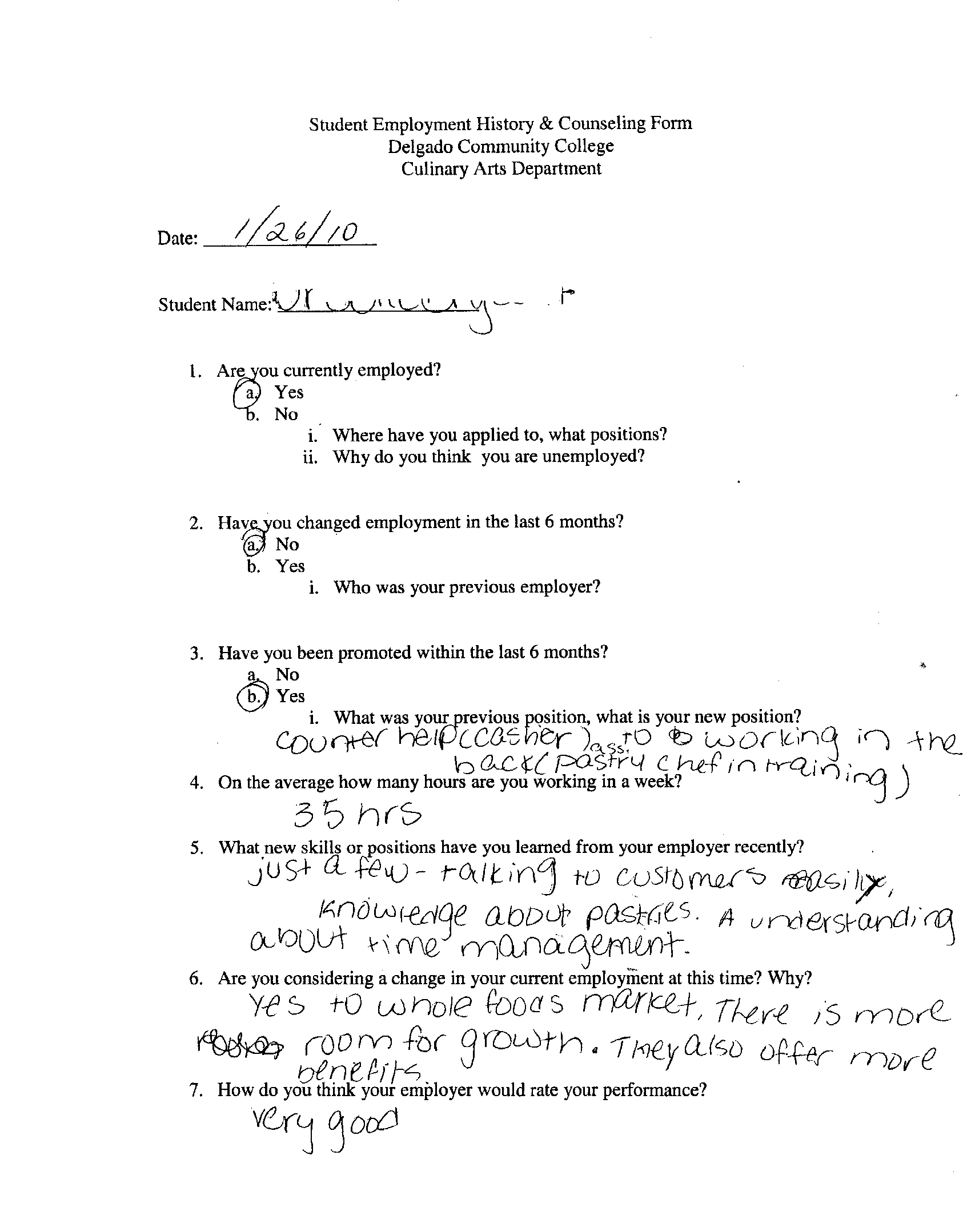
In addition to the continued review of student log books and evaluation of student
performance by industry chefs, students meet with program faculty and complete an
Employment History and Counseling Form to assist with the gathering of information
pertinent to student experiences.
Evidence Included:
A. Sample Student Employment History and Counseling Forms from Fall 2009 and
Spring 2010.
CULA Outcome #3: Summary
CULA Outcome #3 (A): Sample Student Employment History and Counseling Form; implemented 2009-2010, page 1
CULA Outcome #3 (A): Sample Student Employment History and Counseling Form; implemented 2009-2010, page 2
CULA Outcome #3 (A): Sample Student Employment History and Counseling Form; implemented 2009-2010, page 3
CULA Outcome #3 (A): Sample Student Employment History and Counseling Form; implemented 2009-2010, page 4
CULA Outcome #3 (A): Sample Student Employment History and Counseling Form; implemented 2009-2010, page 5
CULA Outcome #3 (A): Sample Student Employment History and Counseling Form; implemented 2009-2010, page 6
CULA Outcome #3 (A): Sample Student Employment History and Counseling Form; implemented 2009-2010, page 7
CULA Outcome #3 (A): Sample Student Employment History and Counseling Form; implemented 2009-2010, page 8